-
The complaint I hear most often
-
The part that never makes it into the purchase order
-
The assumption about price runs backwards
-
It's usually the dye lot, not the dye
-
Custom printed velvet fails differently
-
What the mismatch actually costs
-
What actually works (briefly)
-
When this isn't worth the effort
-
Where this lands
The complaint I hear most often
You approved a swatch. You placed the bulk order. The rolls arrive, and something's off. The color is close. The hand feel is close. Close enough that shipping it back feels dramatic. Not close enough that your client won't notice.
Quick context on where I'm coming from: I'm the quality and brand compliance manager at a fabric sourcing company. I review every lot before it ships to a customer—roughly 200 a year, maybe 180, I'd have to check the system. So far this year I've rejected around 18% of first-submission samples. Almost every one of those rejections was a color or hand-feel issue, and almost none of them were the supplier being dishonest.
That last part is what most buyers get wrong, and it's why the problem keeps repeating even after they switch vendors.
The part that never makes it into the purchase order
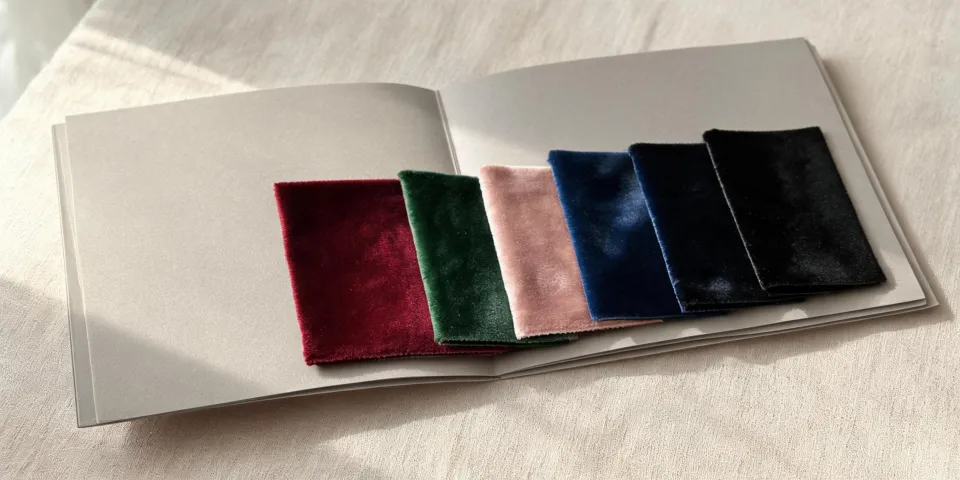
Here's the pattern. The buyer sends a swatch and asks for bulk velvet fabric, 'same as this.' The factory quotes, produces, ships. Both sides believe they agreed on the same thing. They didn't.
They agreed on a swatch—a small piece of one dye lot, viewed under whatever lighting happened to be in the room, on one particular base fabric, at one particular pile height. Production happens on a different lot, a different machine, often a different base fabric supplier, and gets inspected under different light. Sometimes in a different country.
So the deep problem isn't the factory. It's that a swatch isn't a specification. It's a picture. And a picture can't be measured, tested, or disputed in any useful way.
What you end up with is a quality argument that both sides lose. The factory points to their internal tolerance and says the roll is within range. The buyer points at the swatch and says it plainly isn't the same thing. Both are technically correct, which is the worst possible outcome, because now nobody has a number to settle it with.
The assumption about price runs backwards
People think paying more buys better quality. In my experience the causation is reversed: suppliers who can guarantee consistency charge more because consistency is expensive. Dye-lot tracking, retained approval samples, pre-production lab dips, pile-height checks on every lot—that's all overhead. The price reflects the system. The system is what produces the quality, not the invoice amount.
Which explains a pattern I've watched repeat four times in a row: a buyer has a bad run, blames the supplier, switches, pays more, gets another bad run. Same problem, different letterhead. The specification gap followed them.
It's usually the dye lot, not the dye
When color drift shows up, the first suspect is always the dye recipe. More often it's the dye lot, and more often than that, it's the base fabric underneath.
Two rolls can leave the same factory, made to the same recipe, on the same day, and still read differently because the greige fabric came from different suppliers or different production runs. Velvet is unforgiving here. The pile absorbs light at an angle, so a 1–2% difference in base shade can read as a 10% difference once the pile is cut and brushed. This is why 'we use the same dye every time' is a meaningless promise on its own. The only question worth asking is whether the supplier tracks dye lots and base batches and can tell you, before production, which lot your order will run on.
Custom printed velvet fails differently
Custom printed velvet fabric is its own animal. The color-matching conversation moves from the dye house to the print file, and that's where the expensive mistakes live.
Three things go wrong, roughly in order of how often I see them:
- File color versus ink color. A design built in RGB or Pantone looks one way on a monitor and prints another way on a pile-surfaced substrate. Without a physical strike-off, nobody has actually seen the real output—including the person who approved the file.
- Pile interaction. On velvet, the print sits on a surface that moves and catches light. Fine detail that reads crisply on flat cotton goes soft. Small text can disappear entirely.
- Base fabric inconsistency. The same print on a lighter or darker base reads as a different colorway. If the base lot changes between sample and bulk run, the print 'changed' without anyone touching the ink.
None of these are defects. They're predictable, they're testable, and all three get caught by printing a strike-off on the actual production base fabric before the run starts—not after.
What the mismatch actually costs
The visible cost is the rejected roll. The real cost is everything downstream of it.
A few years back we had a 5,000-yard printed velvet order arrive visibly off against the strike-off—two shades darker, more saturated in the pile. The supplier's argument was that it matched the production file, which it did. The file was the problem. Nobody had printed a strike-off on the actual base lot before the bulk run. The redo cost about $38,000 and pushed a launch by three weeks. The supplier covered the production cost. We absorbed the launch delay, which was worse, because the delay was the part our client actually remembered.
There's a quieter cost too. Once a mismatched roll reaches a client, the supplier becomes the story. Doesn't matter whose fault it was by the letter of the contract. I signed off on the delivery, so I own the conversation. As the person with my name on the approval form, I care far more about never having that conversation than about winning the argument afterward.
I went back and forth for two weeks on one sourcing decision—established supplier at a 25% premium versus a newer one with a strong sample and a much better price. On paper the new one won. What kept me on the established one was one question I asked both: 'If this roll comes in two shades off, what happens?' The established supplier described a documented process—retained samples, a tolerance written into the contract, a defined redo clause. The newer one said, 'That won't happen.' That answer told me everything I needed. I paid the 25%.
The spreadsheet doesn't always side with the safer choice, either. I've run the landed-cost analysis on a cheaper supplier and had it come out 15% ahead, then watched that same supplier go silent for nine days when a dye lot failed. The gut signal in that case wasn't mystical—it was response time. Slow to answer a pre-sale question, slow to answer a problem. I just hadn't written it down as a criterion until after the fact.
What actually works (briefly)
I'm not going to hand you a twelve-step procurement manual. Four things do most of the work.
- Write the spec. Not a swatch—a document with base fabric composition, pile height, weight per square yard, color reference, and an explicit tolerance. If a supplier can't tell you their tolerance, that's your answer.
- Lock the dye lot. Ask in writing which lot your order will run on, and require adjacent lots for any rolls that will sit next to each other in the final product.
- Strike off on production base. For custom velvet fabric, approve a strike-off printed on the exact base lot—not a generic sample. This single step has caught more problems for me than the other three combined.
- Keep retained samples. One per accepted lot, labeled, stored. When a dispute surfaces eight months later, this is what settles it without a phone call.
One note on claims. If a supplier promises a colorfastness rating or a pilling result, ask for the test method behind it. Per FTC business guidance on advertising, claims need to be truthful, not misleading, and substantiated with evidence. A supplier who names the standard—ISO 105, AATCC 61, whatever applies—is a supplier who tested. One who says 'it's very colorfast' is guessing, and you'll find out how confident they were the first time it fails.
When this isn't worth the effort
I'd rather be straight with you than pretend the full protocol is universal, because it isn't.
If you're ordering 50 yards for a single installation, a custom strike-off and lot locking may cost you more in time than the risk justifies. Buy from a supplier with a workable return policy, get one good physical sample in your hands, and move on. The protocol exists to protect you from a $38,000 redo, and at 50 yards the downside doesn't reach that number.
The math flips somewhere around the point where a failed run would break a deadline or a client relationship. For most buyers I've worked with, that's in the high hundreds of yards. Below that, physical samples plus clear return terms do the job. Above that, the four steps are cheaper than one bad run.
Same logic applies to custom printed velvet fabric. If the design has fine detail or small text, the strike-off isn't optional—skip it and you're gambling on a pile surface behaving like paper. If it's a bold, large-scale pattern in a single color, you have far more room to move, and I wouldn't push you to run the full process.
Where this lands
The honest summary: most velvet mismatches aren't supplier failures. They're specification failures that get blamed on suppliers afterward. The fix is boring—write it down, lock the lot, print on the real base, keep a sample. None of it is clever, and all of it is cheaper than the second conversation with your client.
That's also the standard I'd hold any velvet fabric wholesale supplier to when you're evaluating one, and it's the standard we hold ourselves to at ClothHarbor Procurement. We track dye lots, retain approval samples, and run strike-offs on production base fabric for custom printed velvet—not because it sounds thorough in a brochure, but because catching it before the run is cheaper than arguing about it after. If you're not sure your current process covers all four steps, that's usually the first conversation worth having.